 Awarded byGuglielmo Marconi University
Postgraduate Diploma in Education
A fully online Postgraduate Diploma in Education — the taught core of the Master's, and a direct pathway into it.
Program Overview
The Postgraduate Diploma in Education (PGDE) is an 8-month, fully online postgraduate qualification designed to equip education practitioners with advanced knowledge, leadership capability, and future-ready skills aligned with contemporary educational priorities. Positioned as the first stage of the Master of Education (M.Ed.) pathway, the programme provides a strong academic and professional foundation for career progression and master’s-level study.
The programme integrates advanced pedagogical practice with strategic and institutional understanding, enabling participants to strengthen curriculum and assessment capability while developing insight into governance, policy, and quality assurance within education systems. Graduates are prepared to operate confidently within complex, regulated, and technology-enabled learning environments.
A strong emphasis on innovation, digital transformation, and generative AI supports responsible and informed adoption of emerging technologies in educational practice. Equity, inclusion, and sustainability are embedded throughout the programme, preparing educators to design inclusive learning environments and contribute to socially responsive and future-oriented education systems.
Delivered through a flexible online learning model, the PGDE prepares reflective practitioners and emerging leaders ready to drive educational improvement and progress to advanced postgraduate study.
Who is it for?
- Practising teachers moving into leadership
- Education professionals broadening their expertise
- Graduates entering the education sector
- Those seeking a pathway to doctoral study
What each module covers
Expand any module to read its description and intended learning outcomes.
Module Description
This module develops advanced capability in designing sustainable and outcomes-driven learning systems aligned with contemporary curriculum frameworks and standards. It examines the strategic integration of curriculum planning, instructional design, and assessment architecture to enhance student success. Students will explore evidence-based pedagogies, differentiated instruction, and formative and summative assessment strategies, with an emphasis on alignment, validity, and continuous improvement. The module positions educators as curriculum leaders capable of designing inclusive, high- impact learning experiences that respond to diverse student needs, regulatory expectations, and evolving educational paradigms.
Learning Outcomes
At the end of the module, the students should be able to:
- LO1Critically analyse curriculum frameworks and align them with institutional and student needs.
- LO2Design instructional strategies grounded in contemporary learning theories.
- LO3Develop valid and reliable assessment systems aligned to learning outcomes.
- LO4Evaluate curriculum, instruction and assessment effectiveness using data-informed decision-making.
Module Description
This module equips students with advanced understanding of governance structures, policy processes, and strategic leadership within complex education systems. It examines the regulatory environment, institutional governance models, and policy formulation and implementation mechanisms that shape educational practice and performance. The module develops strategic leadership capability for driving institutional effectiveness, managing risk, ensuring accountability, and leading systemic reform. Emphasis is placed on ethical governance, stakeholder engagement, and evidence-based decision-making to strengthen student experience, and enhance school, family and community partnerships.
Learning Outcomes
At the end of the module, the students should be able to:
- LO1Critically evaluate different leadership approaches for institutional effectiveness and school reform.
- LO2Critically analyse governance frameworks and regulatory structures governing education systems globally.
- LO3Critically review education policy in institutional and professional contexts.
- LO4Design research-informed strategies to enhance school, family and community partnerships.
Module Description
This module develops advanced capability in understanding, designing, and applying generative artificial intelligence within contemporary education systems. It examines the principles, architectures, and pedagogical applications of generative AI technologies, including large language models across teaching, assessment, student support, and institutional operations. Students critically evaluate the transformative potential, governance implications, and ethical dimensions of generative AI adoption. The module positions graduates to lead responsible AI integration initiatives, design AI-enabled learning solutions, and shape institutional strategies that enhance educational quality, innovation capacity, and organisational performance.
Learning Outcomes
At the end of the module, the students should be able to:
- LO1Critically analyse the principles, capabilities, and limitations of generative AI technologies in educational contexts.
- LO2Critically evaluate pedagogical and organisational use cases of generative AI across teaching, assessment, and student support.
- LO3Critically assess ethical, legal, and governance implications of generative AI adoption in education.
- LO4Design a generative AI–enabled educational solution that addresses an identified teaching, learning, or institutional challenge within responsible AI and governance frameworks.
Module Description
This module advances professional capability in designing equitable, inclusive, and sustainability-driven education systems. It examines inclusive education frameworks, universal design for learning, and differentiated pedagogies to address student diversity and special educational needs. The module integrates Education for Sustainable Development and global citizenship to prepare students to address social, environmental, and economic challenges through education. Students develop strategic perspectives on equity, access, wellbeing, and social impact, positioning them to lead inclusive practice and sustainable institutional development in complex learning environments.
Learning Outcomes
At the end of the module, the students should be able to:
- LO1Critically analyse inclusive education frameworks and differentiated instructional approaches.
- LO2Critically review design strategies for learning environments that align with universal design and accessibility principles.
- LO3Integrate sustainability and global citizenship into curriculum and practice.
- LO4Critically evaluate strategies to enhance equity, access, and student wellbeing.
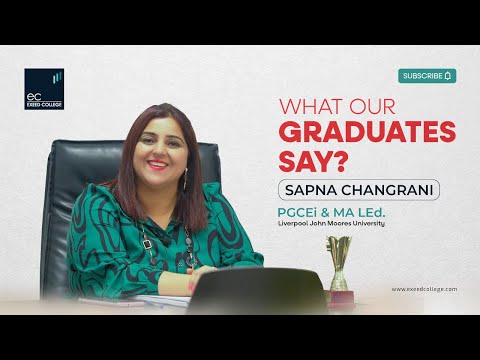
Hear from our graduates
Educators who took this path, in their own words.
 PGDE
PGDE India → UAE
 PGCEIIndia → UAE
 Master'sIndia → UAE
Meet your faculty
Learn from an experienced, international faculty of practitioner-scholars.






About Guglielmo Marconi University, Italy
Guglielmo Marconi University, Italy
Università degli Studi Guglielmo Marconi, internationally referred to as Guglielmo Marconi University, is the first Italian Open University recognised by the Italian Ministry of Education, University and Research (MIUR).
Guglielmo Marconi University (GMU) promotes the use of innovative learning methodologies and an approach based on the development of interdisciplinary knowledge, skills, and competencies with a particular emphasis on the global perspective. Its diverse community currently has 16,000 students enrolled in graduate and postgraduate programmes, 300 faculty members, and an academic advising team made of more than 200 experts.
Postgraduate Diploma in Education
Issued and conferred by Guglielmo Marconi University, Italy on successful completion. Specimen shown for illustration — names and dates appear on the issued certificate.
How to qualify
Eligibility
What you'll need to apply- Bachelor’s Degree from a recognised university
How you'll learn
A flexible, mentor-led online experience — built so busy educators can upskill without a career break.
- Live & interactive lectures by expert faculty
- Recorded sessions for offline viewing
- World-class curriculum by eminent faculty
- Practical learning through seminars & workshops
- Assignments for module assessments
- Easy-to-use LMS, accessible anywhere
- Online library to further enhance your knowledge
- Real-world skills for a well-rounded experience
Where this qualification takes you
Continue your journey
Lead reform and policy with research-driven doctoral study.
 Italy
ItalyLead reform and policy with research-driven doctoral study.
ItalyLead reform and policy with research-driven doctoral study.
ItalyFrequently asked questions
A postgraduate qualification larger than a certificate. This Postgraduate Diploma in Education is awarded by Guglielmo Marconi University, Italy, studied fully online and worth 40 ECTS. The page positions it as the taught core and first stage of the Master of Education pathway, combining advanced pedagogy with governance, policy and quality assurance.
The programme page lists it as one year, studied fully online, with 40 ECTS across four 10-ECTS modules. Intakes are on request. An advisor can confirm the duration and the next available start date before you apply.
A bachelor's degree from a recognised university is the requirement listed on the page. Taito's advisors confirm eligibility, explain intake dates and walk applicants through the application, so it is worth checking your documents with them before you submit anything.
Four modules of 10 ECTS each: Curriculum, Instruction and Assessment Design; Governance, Policy and Strategic Leadership in Education; Generative AI in Education; and Inclusive, Sustainable and Future-Oriented Education. Together they cover assessment design, institutional governance, responsible use of generative AI, universal design for learning and sustainability.
Length and size. Taito's postgraduate certificates in education are six-month awards, while this Postgraduate Diploma in Education runs for a year and carries 40 ECTS across four 10-ECTS modules. The diploma is described on the page as the taught core of the Master's and a direct pathway into it.
The page positions the diploma as the first stage of the Master of Education pathway and lists a pathway to the M.Ed among the directions graduates take. It is described as the taught core of the Master's. Speak to an advisor about how the two programmes connect for you.
Guglielmo Marconi University, Italy. The award is the Postgraduate Diploma in Education, issued and conferred by the university on successful completion of the programme. Speak to an advisor about how the diploma fits your own plans.